
Taking travel pictures on your doorstep
Juliet lives part of the year in London, so she took to the streets to show you can capture India without all the expense and hassle of travelling there. How did she do it? It’s a great way to practice your photographic story-telling too. Instead of jumping on a plane she joined an ‘Unforgettable India in London’ AirBnB fully immersive walking experience in Alperton. Juliet’s guide was Solo Travel author Vaishali Patel. Her exuberance and knowledge gave an amazing insider view of a fascinating culture in a half day tour of Alperton’s Little India. It’s brimming with travel photo opportunities too.
To take pictures that capture this vibrant Indian community, delicious vegetarian cuisine and unique architecture, required taking a range of cameras and lenses. Authenticity is key and being ready at all times with at least one camera to catch the action or the moment as it happens is crucial. As is keeping an eye of the changeable English weather, so a waterproof, easy to access camera bag is essential. Being an immersive tour, Juliet wanted to be able to capture close ups, lively portraits, great architectural shots and wide angle landscape pictures to establish the spirit of the location. Ideally, wear a jacket with lots of pockets so you can easily grab a flash gun to do fill in for shadows or a large fold up piece of foil as an impromptu reflector


All good photo stories start with a scene setter – something to give both context and an introduction. In this case it was Vaishali. She was born in the UK, but is Indian in origin. To best capture her, Juliet looked for two shots to ‘anchor’ her credentials. The Mother of India mural on a shop gated frontage was perfect for this. Then a more specific aspect of the amazing information she shared with us – like the peacock painting on the Brent Indian Association. While Vaishali was explaining the importance of the peacock as transport for the Hindu god Kartikeya, also known as Murugan, Juliet scouted out the best place to capture her explanation at the start of the walking tour.
Once Vaishali had finished talking to the group, Juliet asked her to move out of the shadows, closer to the subject and interact with the painting. Positioning her in the best light and talking to her so she relaxed and smiled, you can then compose an image that starts to bring to life the story she is telling. Be careful with bright light though as your subject could appear to squint if you aren’t careful.


People always ask what is the secret to taking engaging visual travel images for guide books, magazines and photo libraries. In a nutshell it is thinking of and finding unique angles, and being confident to move things and people around. If you want to look up at something, lie down on the ground – the worst that can happen is you get a bit grubby -, or carry a step ladder to get above a crowded space. This is especially useful if doing the walk during Deepavali, when the streets are vibrant but busy. This way you can frame the action of the festival, in this case marking the spiritual victory of light over darkness and good over evil. Being above the crowd makes it possible to avoid the ‘back of the heads shot’.


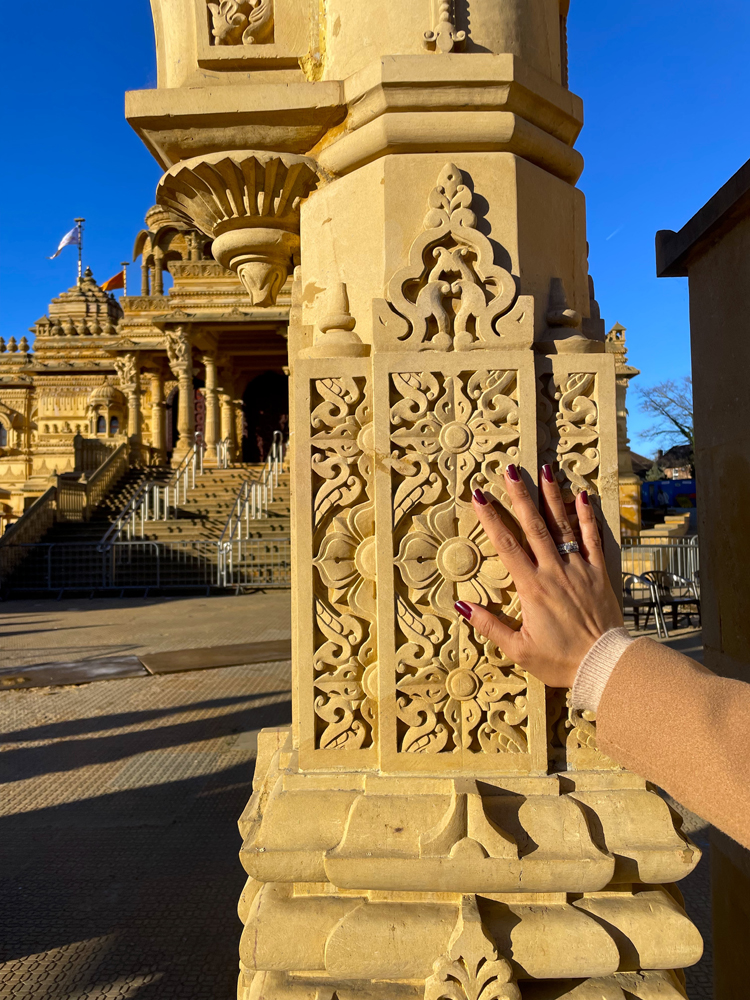
With architecture, for example the Shri Sanatan Hindu temple, asking for someone to put their well manicured hand into the shot caressing the sandstone flower gives it a human element. The line of the arm draws the viewer to the carved detail of the lotus, and additionally makes us, in one small detail of the hand cupping the flower, appreciate how stunning Alperton’s Hindu temple is in artistry.


The three hour walk takes in a huge variety of different photo opportunities; stopping to drape saris or dressing up in pink pantaloons at family run B.L. Joshi fabric emporium, full of gorgeous block printed and hand spun fabrics etc. Then tasting a whole range of Indian sweet samples, made using traditional recipes, in an ultra modern shop.
To avoid the distraction of these sterile environments, you can ask if you can take close ups of the sweet box or catch the naughty child in all of us looking through the counter to pick a few different ones out to taste. Vaishali asked us to guess what the different flavours were and then went onto to explain that Motichor Ladoo is the orange ball, Kaju Katli Pista Barfi, the green one and Habashi Halwa, the brown sweet.The lucky winner of ‘name that sweet’s ingredients’ took the rest of the box home!


The success of the tour lies in meeting lots of different members of the community, and trying all sorts of new things; from buying mung bean woven material to learning about India’s many different gods – in a uber glitzy temple shop called Idols – then capturing all their sparkly details.
The key to great travel pictures is quietly breaking off from the group from time to time to get the behind the scenes photo like the one of the sweet Betel Nut Leaf Paan drawer, from the other side of the wooden counter where all the secret ingredients are kept.
Watching it being made behind glass results in images full of reflections. Instead ask if you can go inside and see where the shop keeper stashes the fresh green leaves and Sweet Paan ingredients – a mix of betel Nut leaf, desiccated coconut, roasted coriander seeds, sugar coated fennel seeds, rose syrup dribbled onto the leaf so everything sticks to it, betel nut and lime.


Close up images of the leaf with all the different ingredients attached, helps us understand what goes inside this minty aromatic taste explosion. Vaishali got everyone to experience eating the sweet Paan leafy green Indian mouth freshener, a concoction we discover is also good for our digestive systems.
The light changes from the start of the morning to midday. To cope with this, you’ll need different strategies. Inside buildings, full of neon artificial lights, contrasts dramatically with crystal blue skies of a sunny outside. Then these turn become slowly grey and overcast towards the middle of the day.
Photography, after all, literally means writing with light, and in an ideal world, starting by shooting in the golden morning sunrise, or late afternoon at sunset, to capture the soft, warm light, would be ideal for atmosphere but wasted on interiors. Early morning light also requires organising a private tour at 7am. If that isn’t feasible, play around with shade and light, maybe shoot into the light putting people or objects between the light source and yourself to create silhouettes. Or use other dramatic effects to take your eye off the overly bright or dull overcast grey conditions.


Travel photography in reality, like a small film trailer, is about capturing the spirit of the experience to make you want to follow in the photographer’s footsteps. It’s aspirational. The secret to images which do this is to work out how best to grab the viewer’s attention, often using unique or unusual angles and perspectives. Combined with clever composition, it’s a different approach to many images currently circulating on the web, Instagram or in print However these can be a useful reference. For example, it’s important, if taking shots of Indian restaurants in London, to research current images online and work out ways to do things differently.
Indian vegetarian food is like a painter’s palette – full of colour and texture. Visualise the colourful creamy vegetarian yoghurt called Chaat, a delicious dish with chickpeas and coriander chutney, with red tomato painted across the surface, is a case in point. Capturing food in quirky ways is crucial to make people stop and look at the dishes, not keep scrolling past. To be different, photographing this yoghurt dish with a macro lens goes in forensically to show how the colourful patterns form in the dish, where natural alchemy takes place. Being a vegetarian experience, why not focus on the green, healthy side of the food and colours associated with it.


With lots of dishes to pick from, you could choose any colour combination from carrots and deep fried orange-coloured food at the buffet to more earthy colours like Dhebra – Indian bread from the Gujarati cuisine, made of pearl millet flower. For those who prefer kitsch images at the other end of the colour spectrum, try capturing the shocking Barbie doll pinks or hot reds. Alternatively, in keeping with Vaishali’s tour, you could choose to capture the spirit of where she comes from in Gujarat – the only state that does not drink alcohol and only eats vegetarian food like the Patra, a steamed vegetarian dish made from Colocasia leaves.
Deciding on a colour palette of greens and yellows, Juliet then moved the dishes to an empty space to draw attention to the ingredients used, creating a cleaner more crafted food shot that worked with the natural light coming through the street window. Once positioned, she threw a few extra leaves in for dramatic effect and closely framed each plate to draw you into and celebrate the world of earthy vegetarian cuisine.


Being mindful of what Vaishali wanted to convey about the artistry of the area, Juliet avoided busy, messy shots of the crowded buffet, metal shiny containers and the group table crowded with crispy bhajiya goodies. Group tables are the worst place to capture the beauty of a meal as half drunk chai teas glasses and a muddle of napkins, forks etc, distract the viewer from the impact of each curated dish. The choices made, with an up close and personal shooting angle, strikingly shows the restaurant’s delicious range of healthy dishes, whilst highlighting its secret ingredient, which is always cooking with love.
In travel photography and on this particular walk, it is important to remember that each picture taken should add to the rich tapestry of India, even if it is in London. Think flavours, cultural gems, clothing experiences, customs and rich traditions, all of which define India as one of the world’s most historically fascinating and vibrant cultures.
As maps were shown of where different foods and fabric patterns come from around India, you realises how many other ways this superb half day ‘India in London’ tour could be visually captured, from a ‘women in travel’ perspective to the artists of Alperton.


It’s more than that though. It’s India, albeit exported to the streets of London, but none the less real, authentic or colourful for it. And it’s a rich tapestry waiting for you to capture.
All images © Juliet Coombe
Ways to join India in London tour:
Discover more about this walking tour – Women in Travel CIC
Find out about AirBnB Experiences
For private groups contact me at vaishali@vaishali-patel.com
Meeting point Alperton Railway Station in the coffee shop. Dress Code: Just remember to be modest for going into the temple and have comfortable walking shoes that are easy to take off.
Check out other features on techniques and experiences on Eye for the Light
