
2026 Solar Eclipse
Across the the Rhine from Bonn, Germany’s former capital and governmental centre, the landscape is dominated by seven hills where the dragon and the dwarves of fairytales lived.
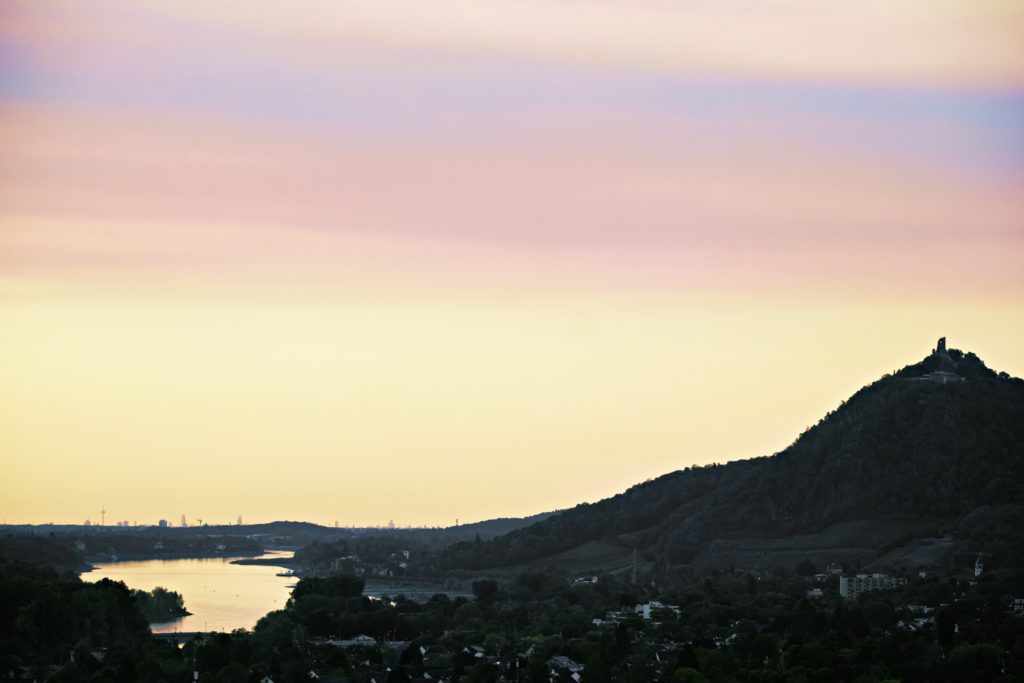
Bonn and the Rhine (left). Drachenfels above Banhonnef and Koenigswinter
The land of dragons and dwarves
The first, and nearest to Bonn is Drachenfels – Dragon’s Rock. It has featured in several old ancient German legends, much in the style of old Norse legend. These stories were passed down orally from generation to generation, until one was written down and immortalised in song and epic poetry. This was the Nibelungenlied – the story of the heroic Siegfried slaying the dragon who lived in a cave on this hill.
From the top of Drachenfels, the views along the Rhine Valley in both directions and south west towards Eiffel National Park are extensive. The Rhine river below flows from the direction o Koblenz in the south, while the views to the north take in nearby Bonn, then Cologne and its famous two-spired cathedral. Some of the rock from the quarry on Drachenfels was used to build this cathedral. Below the Burg is an old Roman quarry and ironically it was quarrying stone from this which ultimately made it unstable, resulting in its ruin. Beyond Cologne is one of Germany’s big coal-mining areas. Most of the mines are now closed and the skyline dominated by wind turbines.


Drachenfels funicular railway from Konigswinter to the summit
Taking the Drachenfelsbahn
The mountain itself has two main building on it. At the top is the ruin of Burg Drachenfels, a castle romanticised by Lord Byron (and others) in his poem Childe Harold’s Pilgrimage. Just below it, is the upper station for funicular rack railway, the Drachenfelsbahn. Lower on the hill is the neogothic castle, Schloss Drachenburg, which amongst other things hosts a German TV series. The funicular connects the riverside town of Koenigswinter with both the Schloss and Burg Drachenfels above transporting visitors up and down the hill all day and into the evening.
August 12th 2026 saw a solar eclipse. In parts of Europe – notably Spain and Iceland – it was total but in Germany it was about 90%. Solar eclipses present an opportunity for some “different” photographs, provided that you can find a good viewpoint. So I decided to give Burg Drachenfels a go, especially as it faced in the right direction but also offers extensive views along the Rhine Valley.


On top of Drachensfel and the ruined Burg
Waiting for the eclipse
Whilst the goal has to be a great shot of a total eclipse with its corona, when the eclipse isn’t total this isn’t possible, but other opportunities open up. First, and even before the eclipse started, this elevated position showed how low the river water level is following a dry summer with virtually no rain fro three months. The Rhine is a major transport link between the Dutch North Sea ports, like Rotterdam, through Germany’s industrial heartland and to southern cities along the river. The summer drought has restricted its use for freight dramatically, and whilst the big barges are still operating, they are doing so with only partial loads.
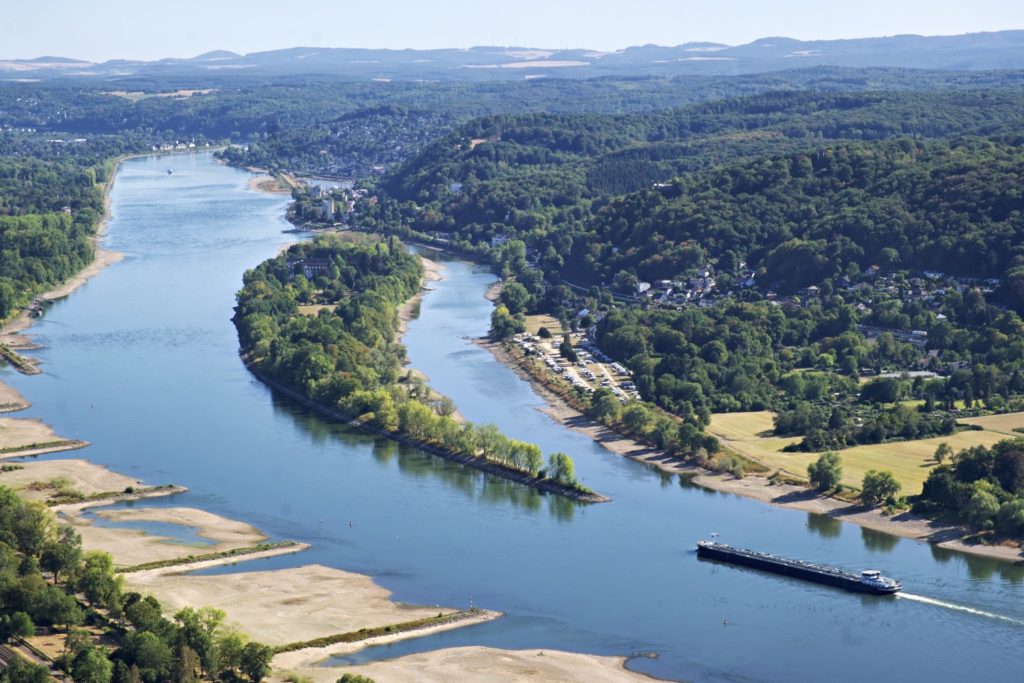
View south along the Rhine showing how low water levels are after a dry summer
Once the eclipse started – about an hour before reaching its maximum – the light starts to change. Here this started about an hours and half before sunset so the sun was already fairly low in the sky. These skies were mostly clear of cloud and the visibility good.
Along the Rhine Valley
In the distance the skyline became more interesting, almost like a watercolour, but an industrial one. A distant power station beyond of Cologne was the back drop for dozens of wind turbines – a poignant statement on the switch away from fossil fuels to more sustainable energy generation. The low water levels due to our changing climate gave this extra relevance. Hot air balloons and paraglides also put in an appearance, gracefully providing another layer to this background.


Views north along the Rhine towards Cologne with wind farms and power stations in the distance
As the eclipse approached its midpoint – when the sun is most obscured – the change in the light is more noticeable. It’s a weird feeling, perhaps best described as the directional light for the time of day, but without the same intensity. Defined shadows, but unlike when sunlight is diffused by clouds. The world also goes silent and birdsong stops. It’s quite eerie and you can understand why similar meteorological and astronomical events like this were given great portents.
Not total but intriguing
Having witnessed a total solar eclipse some 27 years earlier, this was nowhere near as dramatic, but still fascinating. There’s obviously no chance of seeing or photographing a corona but there are still shots to be found. You just need to look and be aware of your surroundings.


Watching the partial eclipse at Burg Drachenfels
In the absence of a total eclipse darkness, this lights captured my attention. Defined shadows but lower contrast giving them more texture. Colours also shift. They have strength without vivid solid intensity of unfiltered direct sunlight, if that makes sense. Looking around there are interesting shifts in light to be observed.
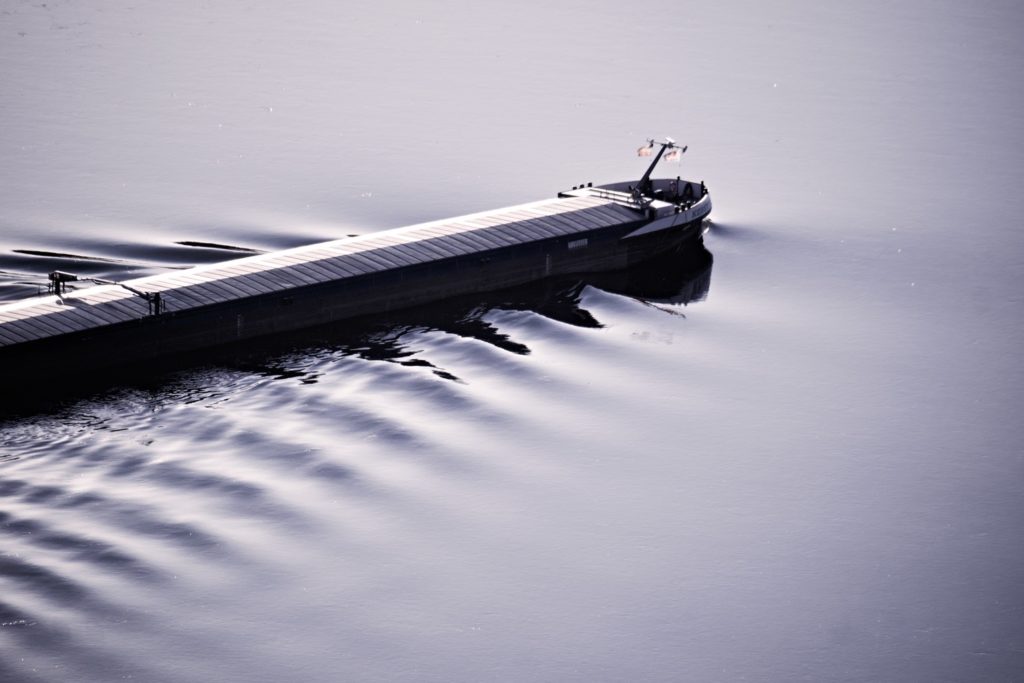
Stillness calms the surface of the Rhine
One which particularly caught my eye was the surface of the Rhine. It became featureless and almost like a mirror. That wasn’t remarkable on its own, but as one of the big barges moves through the frame, a beautiful symmetry emerges as the bow waves take on a smooth elegance.
A different perspective
Almost as if to prove a point about the natural world, the day after the eclipse, a major wild fire started in Eifel National Park. The smoke blew towards Bonn and Drachenfels. At about the same time in the evening – 20.15hrs – as the eclipse this smoke passed in front of the sun turning it scarlet. If was only for a minute or two but it was dramatic and unusual.

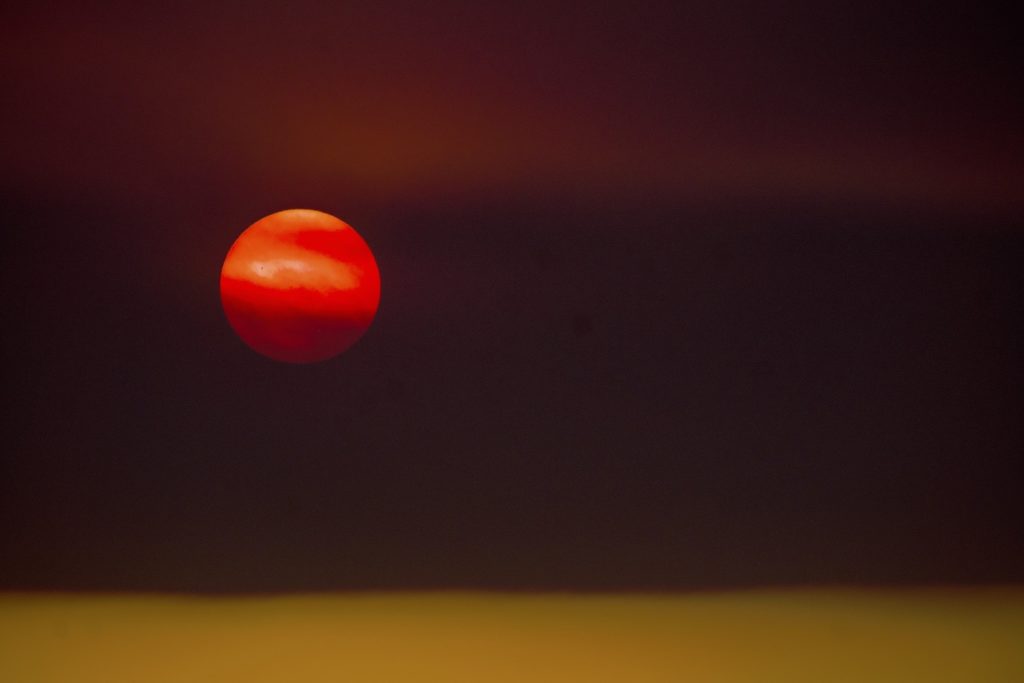
Smoke from wildfires in Eifel National Park drifts in front of the sun long before sunset creating a scarlet orb
I guess the lesson here is that while we all want perfect conditions for our photography, that is rarely what we get. It’s a lesson which stretches your photography and emphasises the importance of observation. Finding the less obvious is what can differentiate our photography from the mass of unengaging picture postcard images which fill our world. If you look for it, our planet opens up lots of other opportunities which we weren’t expecting. So keep looking through creative eyes. Keep searching for something different.
All images © Chris Coe
Find out what Bonn and the surrounding region have to offer
The Drachenfelsbahn railway
Read other features about shooting On Location on Eye for the Light
